
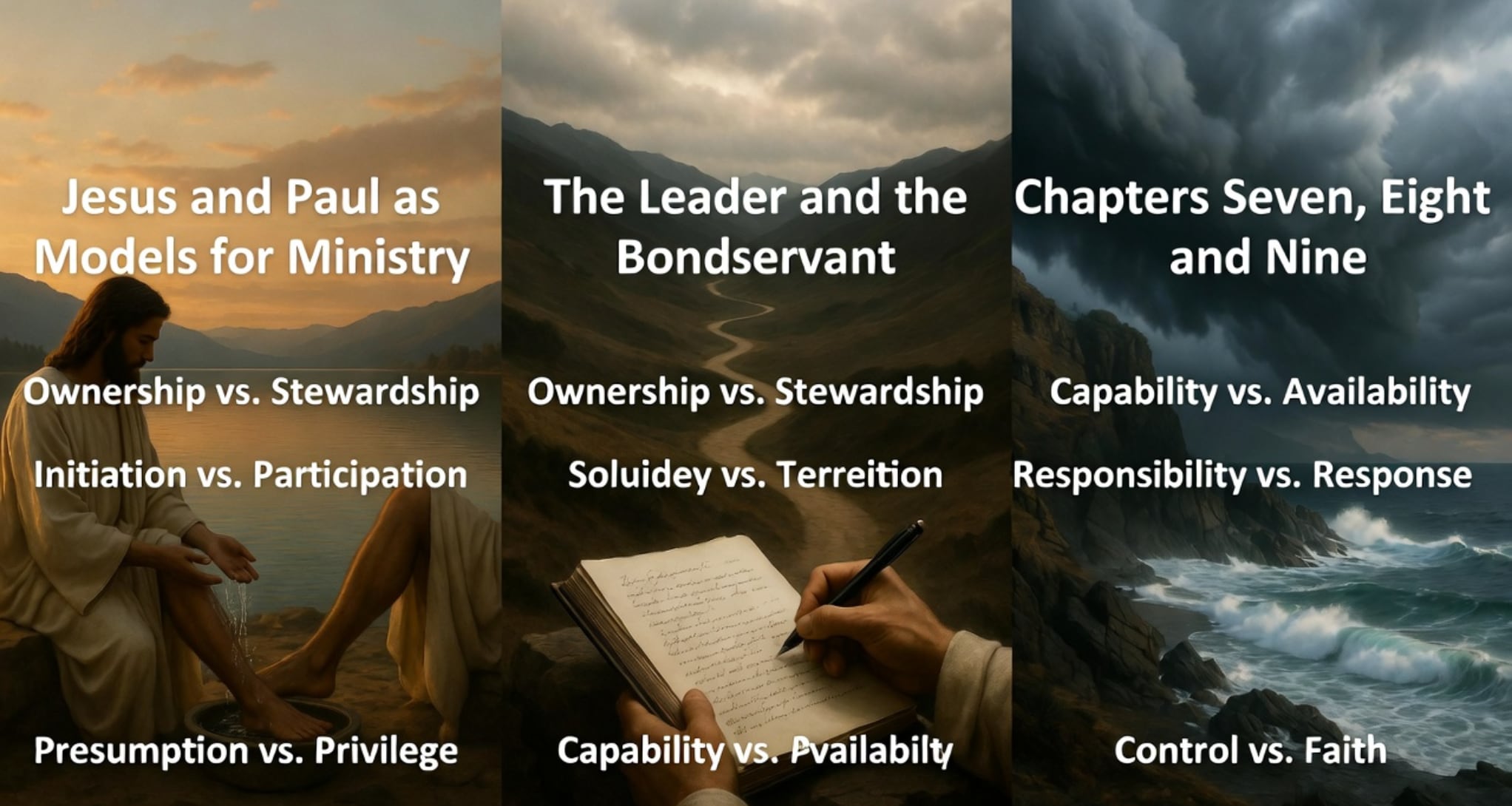
Chapter Seven: Jesus and Paul As Models For MinistryThis chapter presents Jesus and Paul as the primary biblical models for Christian ministry, emphasizing total dependence on God rather than personal initiative or ability.
- Jesus as the Model: Jesus ministered in complete submission to the Father. He only did what the Father planned (John 8:29), was not the initiator of any work (John 5:19, 5:30, 8:28), and was not the source of power—the Father worked through Him (John 14:10). All miracles and ministry flowed from the Father's initiative and power expressed through Jesus.
- Paul as the Model: Paul similarly rejected self-initiation and self-dependence. He participated with God in the gospel (Philippians 1:5), relied on the Spirit's power rather than human wisdom or eloquence (Colossians 1:28; 1 Corinthians 2:4-6; 2 Corinthians 12:9), and attributed all accomplishments to Christ working through him (Romans 15:18; Philippians 4:13). Paul used his intellect and abilities, but only as he participated with Christ, never independently.
The core message is that effective ministry flows from dependence on God's initiative and supernatural power, not human effort.Chapter Eight: Leader? Or Bondservant?This chapter challenges the modern emphasis on "leadership" in ministry and calls ministers to embrace the biblical identity of bondservant (slave) of Christ.
- Leader vs. Bondservant: Jesus explicitly taught, "Do not be called leaders; for One is your Leader, that is, Christ" (Matthew 23:10). Believers are instead called to live as bondslaves of God (1 Peter 2:16) and warned not to become bondservants of men (1 Corinthians 7:23).
- Definition and Characteristics: A bondservant is one who gives himself entirely to another's will, disregarding personal interests. Key traits include total obedience to Christ with sincerity (Ephesians 6:5-8), pleasing Christ rather than people (Galatians 1:10), and subjecting all plans, ideas, and programs to Christ.
- Jesus and Paul as Examples: Neither Jesus nor Paul called themselves leaders. Jesus took the form of a bondservant (Philippians 2:6-7), and Paul repeatedly identified himself as a bondservant of Christ (Romans 1:1; Galatians 1:10).
- Practical Functioning: A bondservant is not quarrelsome, but kind, able to teach, patient when wronged, and gentle in correction (2 Timothy 2:24-25).
- Contrast Table: The chapter includes a detailed comparison between a "Man-Centered Leader" (source: self; initiator: self; dependent on own ability) and a "Christ-Centered Bondservant" (source: Christ; participation with God; dependent on Christ's ability). The former leads to disillusionment, division, and dead works; the latter to unity, transformation, and a truly Christ-built church.
The chapter invites reflection on how viewing oneself as a bondservant rather than a leader would change personal behavior and team decision-making.Chapter Nine: Contrasts In MinistryThis chapter examines six key contrasts between common ministry lies (rooted in human independence) and biblical truths (rooted in dependence on Christ).
- Ownership vs. Stewardship: Lie—treating the ministry as "yours" to succeed or fail. Truth—recognizing it as God's ministry through you, stewarding His grace (1 Peter 4:10).
- Initiation vs. Participation: Lie—initiating vision and plans independently. Truth—participating with God, who initiates and completes the work (Philippians 1:5-6).
- Presumption vs. Privilege: Lie—assuming God needs your abilities or that your ideas are His. Truth—seeing ministry as a gracious privilege granted by God (Ephesians 3:7).
- Capability vs. Availability: Lie—relying on personal intellect and gifts apart from God. Truth—making yourself available for God to work through your gifts.
- Responsibility vs. Response: Lie—feeling personally responsible for outcomes. Truth—responding to God's ability and leading (Colossians 2:6; Romans 8:14).
- Control vs. Faith: Lie—needing to control outcomes and know every step. Truth—walking by faith, trusting God to reveal His plan step by step (John 6:28-29).
The chapter concludes with the consequences:
- Ministering from the "lie" side produces pride, frustration, burnout, condemnation, and dead works from "ministry flesh" (independent effort).
- Ministering from the "truth" side results in personal intimacy with God, supernatural transformation in lives, humility, thanksgiving, joy, and successful building of Christ's church through you.
Overall, these chapters reinforce the book's central theme: Christ alone builds His church when ministers live in complete dependence on Him as bondservants, participating in His work rather than initiating their own.